

close
Choose Your Site
Global
Social Media
Views: 0 Author: Site Editor Publish Time: 2026-04-24 Origin: Site


Not every concrete joint faces the same risk, so Armor Joint types only make sense when they are tied to the problem they are meant to solve. Some floors need better movement control, some need stronger edge protection, some need reinforcement around impact-prone column zones, and some need more reliable connection between concrete sections. Tianheng, the official brand name used by Suzhou Tianheng Engineering Materials Co., Ltd., develops product solutions around these real site demands, and this article focuses on how different armor joint types are grouped and where each one fits.
A useful type article should stay clear and direct. Instead of listing products as if they were isolated catalog entries, it is better to group them by jobsite need. In practice, armor joint types can be understood in four simple directions: movement-related protection, exposed edge protection, column-area protection, and concrete connection.
This approach keeps the topic focused. Readers do not need to start with model numbers. They need to start with the part of the slab that is under pressure. If the main issue is joint opening and traffic stress, one type becomes more relevant. If the main issue is exposed edge damage, another type makes more sense. If the weak point is near a column or a corner transition, the product discussion should move in that direction instead. When the concern is load continuity between concrete sections, connector-based solutions belong in the same conversation.
That is the simplest way to understand armor joint classification. The type is not only about shape. It is about the kind of protection or connection the site actually needs.
Type | Best-fit location | Main problem solved | Content focus |
S-type Armor Joint | Movement joints in heavy-use floors | Movement plus stress at the joint line | Flexibility and strength |
Edge Protection Armor Joint | Exposed slab edges and traffic-prone edges | Early edge wear and impact damage | Edge durability |
Column Wrap Armor Joint | Column-adjacent areas and corner transitions | Localized impact and edge vulnerability | Special protection around layout changes |
Concrete Connector | Adjacent concrete sections | Load sharing and connection stability | Continuity across slabs |
This structure helps readers compare types without turning the article into a long list of repeated definitions.
S-type Armor Joint is most relevant where slab movement and mechanical stress both matter. Some floors do not only need edge reinforcement. They also need a joint arrangement that can work under shrinkage-related opening while continuing to perform under repeated traffic. In those cases, the joint type must address more than one challenge at the same time.
This is why S-type belongs in its own category. It answers a more demanding site condition where movement cannot be ignored and traffic pressure cannot be treated lightly. Warehouses, industrial floors, and other high-use slab systems may need that balance if the joint line is expected to remain reliable over time.
The value of S-type should be described in practical terms. It is not enough to call it strong or durable in a general way. Its real value is that it supports a more controlled working condition where the joint line faces both movement and service stress. That makes it useful for projects where the slab must keep performing under harder crossing conditions.
For customers reading Tianheng product content, this type should feel like a decision based on floor behavior, not a slogan. The key message is simple: when movement and load-related stress meet at the same joint line, S-type Armor Joint becomes a more purposeful option.
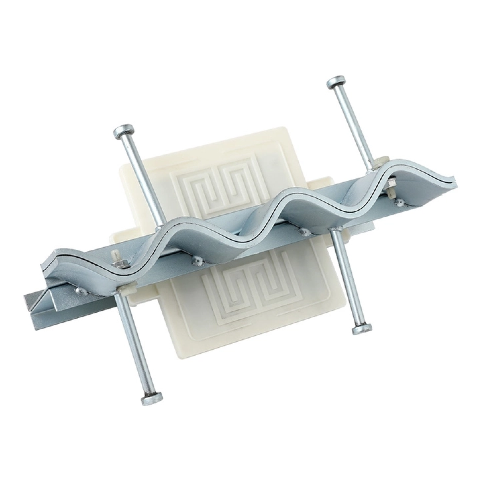
Some projects are defined by one clear weakness: the concrete edge is the first place likely to fail. This often happens at slab boundaries, traffic-facing edges, bridge-related areas, tunnel approaches, industrial edge lines, and other exposed locations where repeated contact and impact attack the edge directly.
In these conditions, the main issue is not only how the slab moves. The main issue is whether the edge can stay intact under use. Once an exposed edge begins to chip or break, the surface quickly loses its clean crossing condition. That affects appearance, maintenance, and long-term service quality.
Edge protection is not a minor detail. On many sites, it is the first real test of whether the floor detail was right or wrong. A slab may appear sound across a large area, yet the exposed edge shows damage much earlier if it is under-protected. That is why Edge Protection Armor Joint should be treated as a distinct type rather than a small variation.
Its role is straightforward: it strengthens the part of the slab that is most vulnerable to impact and wear. For projects where edge abuse is expected from the start, this type gives the discussion a much clearer direction. It also makes the article more useful because readers with edge-related damage can immediately recognize the category that fits their concern.
Column Wrap Armor Joint should be discussed carefully and practically. The focus should remain on where it is used rather than on unsupported technical detail. Around columns, corners, and geometry changes in the slab layout, local stress often becomes more concentrated. Traffic turns more sharply, impact may hit from different directions, and edge vulnerability increases around these transition zones.
That makes column-area protection a reasonable category of its own. The point is not to describe it as a universal solution. The point is to show that some slab areas need more focused protection because the layout itself creates a harder service condition. When the jobsite includes column-adjacent movement or impact-prone corners, this type becomes easier to understand.
Concrete Connector may look different from a typical exposed-edge joint type, but it belongs in the same article because some types are defined by connection logic rather than edge shape. In many concrete floor systems, the important issue is not only protecting one visible edge. It is also maintaining better continuity and load sharing between adjacent concrete sections.
This is where Concrete Connector fits naturally into the type discussion. It supports the broader performance of connected slab areas and helps explain that armor-joint-related products are not limited to one visual form. Some are chosen because of movement need, some because of edge exposure, and some because the connection between sections must remain stable under service.
A weak type article often repeats the same pattern without giving the reader anything new. It says what the product is, then says it is durable, then moves to the next name and does the same again. That kind of writing looks long but does not help the reader understand differences.
A better structure is much simpler. For each type, begin with the problem it solves. Then explain the location where it fits best. After that, state the value it brings to the project in practical language. This approach keeps the article readable and keeps each section distinct.
That is especially important for a product-focused blog on the Tianheng website. The article should help readers identify the right category quickly, not bury the key difference under repeated marketing phrases. When each type is linked to a clear site condition, the content becomes more useful for search, more natural to read, and more likely to support inquiry.
Armor Joint types are easiest to understand when they are grouped by jobsite need: movement-related protection, exposed edge protection, column-area protection, or concrete connection. This keeps the article focused on classification and helps readers connect each type to a real concrete condition instead of treating all products as interchangeable. Tianheng develops these product directions to support demanding floor and structural applications with more targeted protection where it matters most. If your project needs a clearer match between site condition and joint detail, contact us to discuss the right solution, including Column Wrap Armor Joint for areas where localized protection is especially important.
The simplest way is to group them by the problem they solve, such as movement control, edge protection, column-area protection, or connection between concrete sections.
It is more suitable when the joint line must handle both slab movement and heavier mechanical stress in active service conditions.
It is treated as a separate type because exposed slab edges often fail earlier than the rest of the floor and need focused reinforcement against wear and impact.
Concrete Connector belongs in the discussion because some projects need stronger connection and load continuity between concrete sections, not only edge protection at the surface.


