

close
Choose Your Site
Global
Social Media
Views: 0 Author: Site Editor Publish Time: 2026-08-09 Origin: Site


In heavy-duty industrial facilities, 80-90% of concrete floor maintenance issues originate at the joints due to the relentless impact of hard-wheeled traffic. Unprotected contraction and expansion joints, combined with the natural curling of concrete slabs during the curing process, create highly vulnerable impact points. When left unaddressed, these weak points lead to cascading operational costs, including severe concrete spalling, damage to expensive material handling equipment (MHE), and significant operational downtime.
To combat these issues, engineers specify armored joints—also referred to in industry standards as engineered concrete construction joints or heavy-duty industrial floor joints. These specialized profiles serve a critical dual purpose: they act as permanent formwork during the concrete pour and provide robust edge armor for the lifespan of the floor. Positioning the specification of an engineered Armor Joint during the design phase is a structural necessity for heavy-duty environments, moving industrial flooring beyond standard saw-cut joints to permanent, maintenance-free edge protection.
Impact Mitigation: Armor joints eliminate the primary cause of joint spalling by providing a continuous steel transition for hard-wheeled traffic.
Profile Selection Matters: The choice between a cold drawn flat steel armored joint and a punched and bent armored joint dictates load capacity, installation tolerance, and long-term durability.
Vibration Reduction: Advanced profiles, such as the S Type armor joint, are required for facilities utilizing automated guided vehicles (AGVs) or multidirectional forklift traffic.
Concrete naturally shrinks as it cures, causing the edges of the slab to curl upward at joint intersections. This curling creates a slight elevation difference between adjacent slabs. When heavy forklifts equipped with hard polyurethane or Vulkollan wheels strike these raised, unprotected edges, the repetitive impact generates micro-fractures in the concrete. Over time, these micro-fractures propagate, leading to severe joint spalling and structural degradation. The physics of concrete shrinkage dictate that a standard slab will shrink approximately 3mm for every 10 meters of length. This movement must be accommodated without exposing the fragile aggregate matrix at the slab edge.
Armor joints function as both day-joints and permanent protectors. During construction, they act as boundary forms that contain daily concrete pours, ensuring a clean, straight edge. Once the concrete cures, the embedded steel profile remains in place, shielding the fragile concrete arris from direct wheel impact and preventing the physical breakdown of the slab edge. The integration of shear studs welded to the steel profiles ensures that the armor remains permanently anchored within the concrete matrix, even under extreme dynamic loading.
Load Transfer Efficiency (LTE) is a critical metric defined in standards like ACI 224.3R-95 and NRMCA CIP 6. It measures the ability of a joint to transfer dynamic and static loads from one slab panel to the next. Armored joints integrate heavily engineered plate dowels that slide within sleeves, allowing for horizontal shrinkage while effectively transferring vertical loads across the slab without relying solely on aggregate interlock, which degrades over time. Proper LTE prevents differential deflection between adjacent slabs, which is the primary cause of joint faulting and subsequent wheel impact damage.
Standard saw-cut contraction joints are designed to create a weakened plane in the concrete, controlling where shrinkage cracks occur. While effective for crack control, they offer zero edge protection. In contrast, an armored joint acts as permanent formwork and heavy-duty edge protection, ensuring the joint remains structurally sound under extreme industrial traffic. Relying on saw cuts in high-traffic aisles guarantees future maintenance interventions, whereas armored profiles provide a permanent structural solution.
Traditional engineering practices, such as ACI/USBR guidelines, recommend joint spacing of 24 to 36 times the slab thickness for unreinforced, non-armored contraction joints. This typically results in a dense grid of saw cuts every 4 to 6 meters, creating numerous potential failure points across the warehouse floor. In a standard 10,000 square meter facility, this approach can result in over 3,000 linear meters of unprotected joints, all of which are susceptible to spalling and degradation.
The introduction of heavy-duty armor joints revolutionizes floor layout design. By utilizing these engineered profiles, designers can transition to jointless slab designs—large-area pours that can span up to 50m x 50m without a single saw-cut. All concrete movement and shrinkage are concentrated solely at the armored construction joint boundaries, drastically reducing the total linear meters of joints exposed to traffic. This layout strategy requires careful consideration of the concrete mix design, specifically the use of steel fibers or macro-synthetic fibers to control mid-panel shrinkage cracking.
Selecting the correct joint depth based on slab thickness is a strict engineering requirement. The anchor system of the armor joint must sit properly within the top third of the slab to maximize pull-out resistance. Furthermore, the profile depth must be specified to ensure it does not interfere with internal reinforcement steel or post-tensioning cables.
Slab Thickness (mm) | Recommended Joint Height (mm) | Dowel Plate Thickness (mm) |
|---|---|---|
150 - 170 | 130 | 6 |
180 - 200 | 150 | 8 |
210 - 230 | 175 | 10 |
240 - 300 | 200 | 12 |
The manufacturing process for a Cold Drawn Flat Steel Armored Joint involves pulling steel through a die at room temperature. This cold drawing process yields exceptionally sharp, precise arris edges and significantly higher tensile strength compared to standard milled steel. These joints are specified for high-tolerance floors, such as Very Narrow Aisle (VNA) warehouses, where minimal joint gaps and maximum impact resistance are non-negotiable. The sharp edge ensures that wheels transition smoothly across the gap without dropping into the joint.
A Punched and Bent Armored Joint is fabricated by folding sheet steel into the desired profile. This process inherently creates a slightly radiused edge compared to cold-drawn variants. These joints are ideal for standard-duty warehouses, manufacturing facilities, and areas subjected to pneumatic or larger-wheeled traffic. While they are highly effective for general industrial use, the radiused edge may offer slightly less protection against the hardest micro-wheels operating under maximum loads.
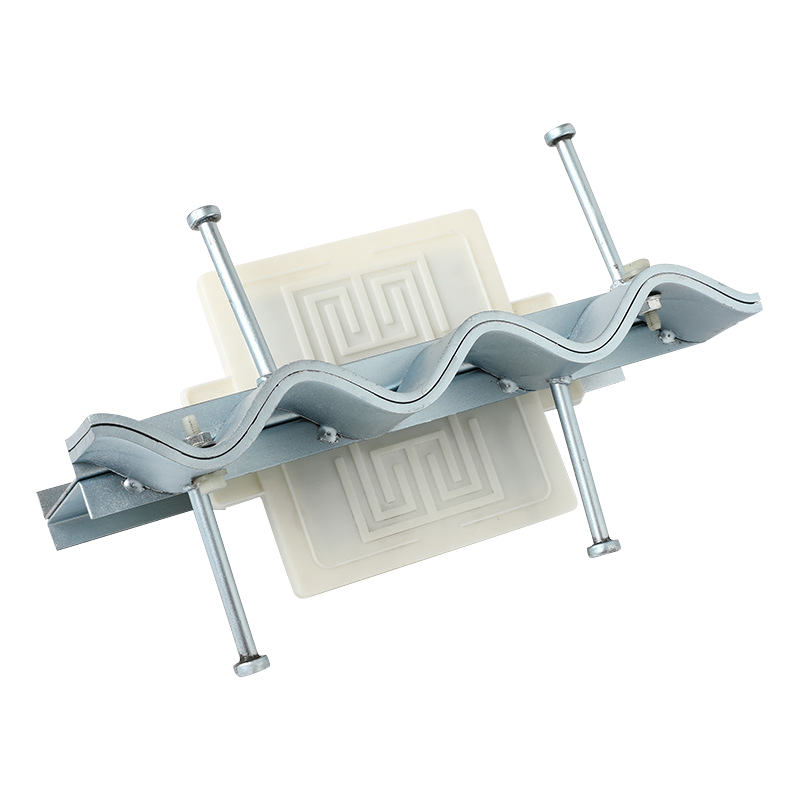
The S Type Armor Joint features a continuous wave, or sinusoidal, design. This geometry completely eliminates the straight-line impact point that wheels typically encounter when crossing a joint. S Type profiles are mandatory for facilities operating Automated Guided Vehicles (AGVs), robotics, or heavy multidirectional traffic where wheel impact must be completely neutralized to prevent sensor disruption. The overlapping steel design ensures that the wheel is always in contact with the metal profile, regardless of the gap width.
Matching the joint profile to the specific material handling equipment is crucial. Pneumatic tires exert a wider, softer footprint, allowing for standard punched and bent profiles. Conversely, solid rubber, polyurethane, or Vulkollan wheels on heavy reach trucks concentrate immense pressure onto a tiny contact area, necessitating the sharp precision of cold-drawn steel or the impact-neutralizing geometry of an S Type joint.
The operational environment dictates the material finish of the armor joint. Standard mill steel is sufficient for dry, indoor warehouses. However, facilities involving food-grade processing, chemical washdowns, or exterior environments require galvanized or full stainless steel options to prevent corrosion and maintain sanitary standards. In aggressive chemical environments, the steel profile must be paired with a highly resistant joint sealant to protect the underlying dowel mechanisms.
Even with armor joints, the gap that opens due to concrete shrinkage must be managed. Specifiers must address the interaction between the steel profiles and joint sealants, such as semi-rigid epoxy or polyurea. A joint filler is typically required to prevent debris ingress, which can restrict joint movement. However, advanced S Type profiles maintain such a tight, overlapping gap that they can often bypass the need for traditional elastomeric sealants.
A major installation risk is poor concrete consolidation under the steel profile, known as honeycombing. If the concrete does not fully encapsulate the shear studs, the joint will fail under load. This risk is mitigated through continuous pour monitoring and the strict requirement for proper internal vibration along the joint during concrete placement.
Set the joint profile to the exact finished floor elevation using a laser level.
Secure the joint using steel installation pins driven into the subbase.
Verify that the joint is perfectly plumb to ensure the dowels remain horizontal.
Apply internal vibration directly adjacent to the steel profile during the concrete pour.
Sever all nylon tying wires immediately after the concrete has achieved initial set to allow for unrestricted shrinkage.
Armor joints can be adapted into true isolation or expansion joints by incorporating pre-installed compressible foam or isolation liners. It is a critical requirement to honor these expansion joints through the entire depth of the slab and up through any surface finishes, such as ceramic tile or epoxy coatings, to prevent reflective cracking. Failure to accommodate thermal expansion will result in severe structural damage to the surrounding concrete panels.
Incorrect elevation setting is a frequent contractor error; if the joint sits even a millimeter above or below the finished floor level, it creates an immediate impact point. Furthermore, failure to sever the nylon tying wires that hold the joint together during transport restricts natural slab shrinkage, leading to mid-panel cracking. Contractors must also ensure that the dowel sleeves are perfectly aligned and free of concrete slurry to allow for smooth horizontal movement.
Standard saw-cut joints are structurally insufficient for heavy-duty industrial floors subjected to hard-wheeled traffic. Armor joints represent a necessary structural investment to protect the slab's most vulnerable points, ensuring long-term operational efficiency.
Consult structural engineers for precise dowel load calculations prior to specification.
Mandate contractor mock-ups prior to full-scale installation to verify elevation tolerances and consolidation techniques.
Specify the exact joint profile based on the specific wheel hardness and traffic patterns of the facility.
Implement a strict quality control checklist during the concrete pour to ensure proper internal vibration around the shear studs.
A: Standard contraction joints are saw cuts that induce a weakened plane to control cracking. Armor joints are pre-installed steel profiles that act as leave-in-place formwork and physically protect the concrete edge from hard-wheeled impact.
A: Standard saw-cut contraction joints typically follow a strict rule of 24 to 36 times the slab thickness, usually requiring cuts every 4 to 6 meters. Armor joints are designed as boundary construction joints, allowing for jointless slab layouts where panels can span up to 50 meters between armored joints.
A: Specify S Type joints in facilities utilizing Automated Guided Vehicles (AGVs), very narrow aisles (VNA), or where multidirectional hard-wheeled traffic requires zero-impact, vibration-free transitions to protect sensitive equipment and sensors.
A: Yes, in many environments, the gap that opens up due to concrete shrinkage should be filled with a semi-rigid joint filler like polyurea to prevent debris accumulation. However, some sinusoidal S Type profiles minimize the impact gap so effectively that traditional filler maintenance is significantly reduced.
A: They provide a highly precise, sharp edge that minimizes the joint gap. They work in tandem with integrated plate dowels to transfer heavy static and dynamic loads across the slab without relying on aggregate interlock.
A: Concrete joint spalling is primarily caused by the repetitive impact of hard-wheeled material handling equipment striking the curled, unprotected edges of standard concrete joints, leading to micro-fractures and eventual concrete breakdown.


